"J'ai toujours rêvé d'un ordinateur qui soit aussi facile à utiliser qu'un téléphone. Mon rêve s'est réalisé : je ne sais plus comment utiliser mon téléphone."
Bjarne Stroustrup (le père du langage C++).
dimanche 26 septembre 2010

samedi 25 septembre 2010
dimanche 8 août 2010


dimanche 2 mai 2010
samedi 1 mai 2010
lundi 1 mars 2010
dimanche 21 février 2010


jeudi 31 décembre 2009
Housse pour Archos 5 IT
Bonjour,
Je cherchais une housse pour mon Archos 5 IT qui réponde aux critères suivants :
- pas chère,
- peu épaisse (si j'ai choisi la version Flash 32Go de l'Archos 5 IT, ce n'est pas pour me retrouver avec un truc qui fasse 2 ou 3 centimètres d'épaisseur au final),
- que je puisse glisser facilement dans la poche intérieur de ma veste,
- me permettant de laisser le fil de mes écouteurs branché en permanence pour écouter ma zik pendant les trajets,
- qui protège mon A5IT, écran compris (sinon, ce n'est pas une housse... :-)).
Ma femme l'a fait : un sweat trop court de mon fils, un bout de manche découpé, 2 coutures et voilà une housse pour mon Archos 5 IT bien douce (extérieur comme intérieur) et qui empêche l'A5IT de sortir tout seul grâce au bout de manche resserré.

Je cherchais une housse pour mon Archos 5 IT qui réponde aux critères suivants :
- pas chère,
- peu épaisse (si j'ai choisi la version Flash 32Go de l'Archos 5 IT, ce n'est pas pour me retrouver avec un truc qui fasse 2 ou 3 centimètres d'épaisseur au final),
- que je puisse glisser facilement dans la poche intérieur de ma veste,
- me permettant de laisser le fil de mes écouteurs branché en permanence pour écouter ma zik pendant les trajets,
- qui protège mon A5IT, écran compris (sinon, ce n'est pas une housse... :-)).
Ma femme l'a fait : un sweat trop court de mon fils, un bout de manche découpé, 2 coutures et voilà une housse pour mon Archos 5 IT bien douce (extérieur comme intérieur) et qui empêche l'A5IT de sortir tout seul grâce au bout de manche resserré.

dimanche 29 novembre 2009
Machine à remonter le temps
A chaque fois que je me regarde dans un miroir, je vois un ancien moi : celui que j'étais 2 nanosecondes plus tôt.
Pas besoin de s'appeler H. G. Wells pour avoir une machine à remonter le temps chez soi ! ... :-)
Pas besoin de s'appeler H. G. Wells pour avoir une machine à remonter le temps chez soi ! ... :-)
lundi 19 octobre 2009
samedi 22 août 2009
Paradoxe du barbier
Sur l’enseigne du barbier du village, on peut lire : "Je rase tous les hommes du village qui ne se rasent pas eux-mêmes, et seulement ceux-là".
Qui rase le barbier ?
Qui rase le barbier ?
samedi 18 juillet 2009


mardi 30 juin 2009
samedi 27 juin 2009
Quelques perles de Jean-Claude Van Damme
- "Si tu attends le mois d'octobre pour faire des poissons d'avril, tu attrapes plus de gens."
- "Si tu travailles avec un marteau-piqueur pendant un tremblement de terre, désynchronise-toi, sinon tu travailles pour rien."
- "J'adore les cacahuètes. Tu bois une bière et tu en as marre du goût. Alors tu manges des cacahuètes. Les cacahuètes, c'est doux et salé, fort et tendre, comme une femme. Manger des cacahuètes, "it's a really strong feeling". Et après tu as de nouveau envie de boire de la bière. Les cacahuètes c'est le mouvement perpétuel à la portée de l'homme."
- "Dans les magasins de lingerie, on ne voit pas de calendriers avec des photos de garage."
- "Une femme qui est enceinte, par exemple, elle est aware qu'elle attend un enfant. "
- "La vie c'est quelque chose de très fort et de très beau. La vie appartient à tous les vivants. "It's both a dream and a feeling". C'est être ce que nous ne sommes pas sans le rester. La vie c'est mourir aussi. Et mourir c'est vraiment strong, c'est rester en vie au delà de la mort. Tous ceux qui sont morts n'ignorent pas de le savoir. "
"Moi, Adam et Eve, j'y crois plus tu vois, parce que je suis pas un idiot : la pomme, ça peut pas être mauvais, c'est plein de pectine."
- "Un biscuit ça n'a pas de spirit. C'est juste un biscuit. Mais, avant c'était du lait, des œufs. Et dans les œufs, il y a la vie potentielle. "
- "Je suis fasciné par l'air. Si on enlevait l'air du ciel, tous les oiseaux tomberaient par terre. Et les avions aussi. En même temps l'air tu peux pas le toucher...ça existe et ça existe pas. Ca nourrit l'homme sans qu'il ait faim. "It's magic". L'air c'est beau en même temps tu peux pas le voir, c'est doux et tu peux pas le toucher... L'air c'est un peu comme mon cerveau. "
- "Si tu travailles avec un marteau-piqueur pendant un tremblement de terre, désynchronise-toi, sinon tu travailles pour rien."
- "J'adore les cacahuètes. Tu bois une bière et tu en as marre du goût. Alors tu manges des cacahuètes. Les cacahuètes, c'est doux et salé, fort et tendre, comme une femme. Manger des cacahuètes, "it's a really strong feeling". Et après tu as de nouveau envie de boire de la bière. Les cacahuètes c'est le mouvement perpétuel à la portée de l'homme."
- "Dans les magasins de lingerie, on ne voit pas de calendriers avec des photos de garage."
- "Une femme qui est enceinte, par exemple, elle est aware qu'elle attend un enfant. "
- "La vie c'est quelque chose de très fort et de très beau. La vie appartient à tous les vivants. "It's both a dream and a feeling". C'est être ce que nous ne sommes pas sans le rester. La vie c'est mourir aussi. Et mourir c'est vraiment strong, c'est rester en vie au delà de la mort. Tous ceux qui sont morts n'ignorent pas de le savoir. "
"Moi, Adam et Eve, j'y crois plus tu vois, parce que je suis pas un idiot : la pomme, ça peut pas être mauvais, c'est plein de pectine."
- "Un biscuit ça n'a pas de spirit. C'est juste un biscuit. Mais, avant c'était du lait, des œufs. Et dans les œufs, il y a la vie potentielle. "
- "Je suis fasciné par l'air. Si on enlevait l'air du ciel, tous les oiseaux tomberaient par terre. Et les avions aussi. En même temps l'air tu peux pas le toucher...ça existe et ça existe pas. Ca nourrit l'homme sans qu'il ait faim. "It's magic". L'air c'est beau en même temps tu peux pas le voir, c'est doux et tu peux pas le toucher... L'air c'est un peu comme mon cerveau. "
vendredi 19 juin 2009
Delirium - Etymology
1599, from L. delirium "madness," from deliriare "be crazy, rave," lit. "go off the furrow," a plowing metaphor, from phrase de lire (de "off, away" + lira "furrow"). Delirium tremens is Mod.L., "trembling delirium," introduced 1813 by British physician Thomas Sutton, for "that form of delirium which is rendered worse by bleeding, but improved by opium. By Rayer and subsequent writers it has been almost exclusively applied to delirium resulting from the abuse of alcohol" [Sydenham Society Lexicon of Medicine].
Online Etymology Dictionary, © 2001 Douglas Harper
lundi 25 août 2008
dimanche 11 novembre 2007
mardi 23 octobre 2007
dimanche 30 septembre 2007
dimanche 19 août 2007
Our Lives, Controlled From Some Guy’s Couch
Read in The New York Times :
Until I talked to Nick Bostrom, a philosopher at Oxford University, it never occurred to me that our universe might be somebody else’s hobby. I hadn’t imagined that the omniscient, omnipotent creator of the heavens and earth could be an advanced version of a guy who spends his weekends building model railroads or overseeing video-game worlds like the Sims.
But now it seems quite possible. In fact, if you accept a pretty reasonable assumption of Dr. Bostrom’s, it is almost a mathematical certainty that we are living in someone else’s computer simulation.
Until I talked to Nick Bostrom, a philosopher at Oxford University, it never occurred to me that our universe might be somebody else’s hobby. I hadn’t imagined that the omniscient, omnipotent creator of the heavens and earth could be an advanced version of a guy who spends his weekends building model railroads or overseeing video-game worlds like the Sims.
But now it seems quite possible. In fact, if you accept a pretty reasonable assumption of Dr. Bostrom’s, it is almost a mathematical certainty that we are living in someone else’s computer simulation.
This simulation would be similar to the one in “The Matrix,” in which most humans don’t realize that their lives and their world are just illusions created in their brains while their bodies are suspended in vats of liquid. But in Dr. Bostrom’s notion of reality, you wouldn’t even have a body made of flesh. Your brain would exist only as a network of computer circuits.
You couldn’t, as in “The Matrix,” unplug your brain and escape from your vat to see the physical world. You couldn’t see through the illusion except by using the sort of logic employed by Dr. Bostrom, the director of the Future of Humanity Institute at Oxford.
Dr. Bostrom assumes that technological advances could produce a computer with more processing power than all the brains in the world, and that advanced humans, or “posthumans,” could run “ancestor simulations” of their evolutionary history by creating virtual worlds inhabited by virtual people with fully developed virtual nervous systems.
Some computer experts have projected, based on trends in processing power, that we will have such a computer by the middle of this century, but it doesn’t matter for Dr. Bostrom’s argument whether it takes 50 years or 5 million years. If civilization survived long enough to reach that stage, and if the posthumans were to run lots of simulations for research purposes or entertainment, then the number of virtual ancestors they created would be vastly greater than the number of real ancestors.
There would be no way for any of these ancestors to know for sure whether they were virtual or real, because the sights and feelings they’d experience would be indistinguishable. But since there would be so many more virtual ancestors, any individual could figure that the odds made it nearly certain that he or she was living in a virtual world.
The math and the logic are inexorable once you assume that lots of simulations are being run. But there are a couple of alternative hypotheses, as Dr. Bostrom points out. One is that civilization never attains the technology to run simulations (perhaps because it self-destructs before reaching that stage). The other hypothesis is that posthumans decide not to run the simulations.
“This kind of posthuman might have other ways of having fun, like stimulating their pleasure centers directly,” Dr. Bostrom says. “Maybe they wouldn’t need to do simulations for scientific reasons because they’d have better methodologies for understanding their past. It’s quite possible they would have moral prohibitions against simulating people, although the fact that something is immoral doesn’t mean it won’t happen.”
Dr. Bostrom doesn’t pretend to know which of these hypotheses is more likely, but he thinks none of them can be ruled out. “My gut feeling, and it’s nothing more than that,” he says, “is that there’s a 20 percent chance we’re living in a computer simulation.”
My gut feeling is that the odds are better than 20 percent, maybe better than even. I think it’s highly likely that civilization could endure to produce those supercomputers. And if owners of the computers were anything like the millions of people immersed in virtual worlds like Second Life, SimCity and World of Warcraft, they’d be running simulations just to get a chance to control history — or maybe give themselves virtual roles as Cleopatra or Napoleon.
It’s unsettling to think of the world being run by a futuristic computer geek, although we might at last dispose of that of classic theological question: How could God allow so much evil in the world? For the same reason there are plagues and earthquakes and battles in games like World of Warcraft. Peace is boring, Dude.
A more practical question is how to behave in a computer simulation. Your first impulse might be to say nothing matters anymore because nothing’s real. But just because your neural circuits are made of silicon (or whatever posthumans would use in their computers) instead of carbon doesn’t mean your feelings are any less real.
David J. Chalmers, a philosopher at the Australian National University, says Dr. Bostrom’s simulation hypothesis isn’t a cause for skepticism, but simply a different metaphysical explanation of our world. Whatever you’re touching now — a sheet of paper, a keyboard, a coffee mug — is real to you even if it’s created on a computer circuit rather than fashioned out of wood, plastic or clay.
You still have the desire to live as long as you can in this virtual world — and in any simulated afterlife that the designer of this world might bestow on you. Maybe that means following traditional moral principles, if you think the posthuman designer shares those morals and would reward you for being a good person.
Or maybe, as suggested by Robin Hanson, an economist at George Mason University, you should try to be as interesting as possible, on the theory that the designer is more likely to keep you around for the next simulation. (For more on survival strategies in a computer simulation, go to www.nytimes.com/tierneylab.)
Of course, it’s tough to guess what the designer would be like. He or she might have a body made of flesh or plastic, but the designer might also be a virtual being living inside the computer of a still more advanced form of intelligence. There could be layer upon layer of simulations until you finally reached the architect of the first simulation — the Prime Designer, let’s call him or her (or it).
Then again, maybe the Prime Designer wouldn’t allow any of his or her creations to start simulating their own worlds. Once they got smart enough to do so, they’d presumably realize, by Dr. Bostrom’s logic, that they themselves were probably simulations. Would that ruin the fun for the Prime Designer?
If simulations stop once the simulated inhabitants understand what’s going on, then I really shouldn’t be spreading Dr. Bostrom’s ideas. But if you’re still around to read this, I guess the Prime Designer is reasonably tolerant, or maybe curious to see how we react once we start figuring out the situation.
It’s also possible that there would be logistical problems in creating layer upon layer of simulations. There might not be enough computing power to continue the simulation if billions of inhabitants of a virtual world started creating their own virtual worlds with billions of inhabitants apiece.
If that’s true, it’s bad news for the futurists who think we’ll have a computer this century with the power to simulate all the inhabitants on earth. We’d start our simulation, expecting to observe a new virtual world, but instead our own world might end — not with a bang, not with a whimper, but with a message on the Prime Designer’s computer.
It might be something clunky like “Insufficient Memory to Continue Simulation.” But I like to think it would be simple and familiar: “Game Over.”
dimanche 15 juillet 2007


samedi 16 juin 2007
dimanche 6 mai 2007
Should it be possible to copyright an integer?
1) Any electronic file is a stream of bits, 1s and 0s. For example, a 1MB file contains 8,388,608 bits.
2) Every stream of bits is a binary representation of a unique integer. In 1MB, that integer has about 2,525,223 decimal digits.
3) So every electronic file corresponds to a single unique integer.
4) It is, in many cases, illegal to copy and distribute electronic versions of movies, music, software etc.
5) Therefore, it is illegal to copy and distribute certain integers.
Want more ? See : http://qntm.org/number
2) Every stream of bits is a binary representation of a unique integer. In 1MB, that integer has about 2,525,223 decimal digits.
3) So every electronic file corresponds to a single unique integer.
4) It is, in many cases, illegal to copy and distribute electronic versions of movies, music, software etc.
5) Therefore, it is illegal to copy and distribute certain integers.
Want more ? See : http://qntm.org/number
samedi 28 avril 2007
mardi 27 février 2007
samedi 17 février 2007
samedi 10 février 2007
"This is your life" by Dust Brothers
And you open the door and you step inside
We're inside our hearts
Now imagine your pain as a white ball of healing light
That's right
Your pain, the pain itself is a white ball of healing light
I don't think so
This is your life
Good to the last drop
It doesn't get any better than this
This is your life and its ending one minute at a time
This isn't a seminar
This isn't a weekend retreat
Where you are now you can't even imagine what the bottom will be like
Only after disaster can we be resurrected
It's only after you've lost everything that you're free to do anything
Nothing is static
Everything is evolving
Everything is falling apart
This is your life, This is your life, This is your life, This is your life
It doesn't get any better than this
This is your life, This is your life, This is your life, This is your life
and its ending one minute at a time
You are not a beautiful and unique snowflake
You are the same decaying organic matter as everything else
We are all part of the same compost heap
We are the all singing all dancing crap of the world
You are not your bank account
You are not the clothes you wear
You are not the contents of your wallet
You are not your bowel cancer
You are not your grande latte
You are not the car you drive
You are not your fucking kakeys
You have to give up, You have to give up
You have to realize that someday you will die
Until you know that, You are useless
I say, let me never be complete
I say, may I never be content
I say, deliver me from Swedish furniture
I say, deliver me from clever art
I say, deliver me from clear skin and perfect teeth
I say, you have to give up
I say, evolve, and let the chips fall where they may
This is your life, This is your life, This is your life, This is your life
It doesn't get any better than this
This is your life, This is your life, This is your life, This is your life
and its ending one minute at a time
You have to give up, You have to give up
I want you hit me as hard as you can
I want you hit me as hard as you can
Welcome to fight club
If this is your first night - You have to fight
We're inside our hearts
Now imagine your pain as a white ball of healing light
That's right
Your pain, the pain itself is a white ball of healing light
I don't think so
This is your life
Good to the last drop
It doesn't get any better than this
This is your life and its ending one minute at a time
This isn't a seminar
This isn't a weekend retreat
Where you are now you can't even imagine what the bottom will be like
Only after disaster can we be resurrected
It's only after you've lost everything that you're free to do anything
Nothing is static
Everything is evolving
Everything is falling apart
This is your life, This is your life, This is your life, This is your life
It doesn't get any better than this
This is your life, This is your life, This is your life, This is your life
and its ending one minute at a time
You are not a beautiful and unique snowflake
You are the same decaying organic matter as everything else
We are all part of the same compost heap
We are the all singing all dancing crap of the world
You are not your bank account
You are not the clothes you wear
You are not the contents of your wallet
You are not your bowel cancer
You are not your grande latte
You are not the car you drive
You are not your fucking kakeys
You have to give up, You have to give up
You have to realize that someday you will die
Until you know that, You are useless
I say, let me never be complete
I say, may I never be content
I say, deliver me from Swedish furniture
I say, deliver me from clever art
I say, deliver me from clear skin and perfect teeth
I say, you have to give up
I say, evolve, and let the chips fall where they may
This is your life, This is your life, This is your life, This is your life
It doesn't get any better than this
This is your life, This is your life, This is your life, This is your life
and its ending one minute at a time
You have to give up, You have to give up
I want you hit me as hard as you can
I want you hit me as hard as you can
Welcome to fight club
If this is your first night - You have to fight
dimanche 28 janvier 2007
The Clarkkkkson
A way to define a number not so far from infinity : http://www.lab6.com/old/school/yearbook/clarkkkkson.html
dimanche 19 novembre 2006
samedi 16 septembre 2006
Le Big Bang et la théorie des cordes
Si, comme le laisse entendre la théorie des cordes, le Big Bang est le résultat du choc de 2 (mem)branes :
- a quelle "distance" de la (mem)brane qui nous héberge se trouve sa plus proche voisine ? Quand allons-nous avoir droit à un nouveau Big Bang ?
- l'ironie du sort a-t-elle prévu que nous comprenions la totalité des implications de la théorie des cordes la veille de ce nouveau Big Bang ?
- l'univers à 11 dimensions et des mondes parallèles a-t-il eu droit à une sorte de Big Bang ou n'a-t-il jamais eu de début ?
- a quelle "distance" de la (mem)brane qui nous héberge se trouve sa plus proche voisine ? Quand allons-nous avoir droit à un nouveau Big Bang ?
- l'ironie du sort a-t-elle prévu que nous comprenions la totalité des implications de la théorie des cordes la veille de ce nouveau Big Bang ?
- l'univers à 11 dimensions et des mondes parallèles a-t-il eu droit à une sorte de Big Bang ou n'a-t-il jamais eu de début ?
mercredi 13 septembre 2006
samedi 27 mai 2006
dimanche 21 mai 2006
mardi 11 avril 2006
Mémoire à court terme et mémoire à long terme
"La mémoire humaine n'est pas simplement associative, ne se contente pas de relier des situations, des réactions et des récompenses. Elle est aussi prospective et réflexive. Les connexions établies doivent aussi être impliquées dans des projets et des objectifs à long terme. Voilà la raison d'être de cette importante séparation entre la mémoire à court terme et la mémoire à long terme. Pourquoi faut-il environ une heure pour qu'un souvenir immédiat passe au stade de souvenir à long terme ? Parce qu'il faut qu'il y ait une période tampon, le temps de décider quels comportements ont été réellement assez bénéfiques pour mériter d'être enregistrés."
H. Harrison & M. Minsky
H. Harrison & M. Minsky
Nous sommes nos souvenirs
"Dès que nous avons commencé à 'fonctionner', à penser par nous mêmes, nous avons commencé à changer. N'oubliez pas que nous sommes nos souvenirs. Quand nous oublions quelque chose ou apprenons quelque chose de nouveau, quand nous produisons une nouvelle pensée ou établissons une nouvelle connexion, nous changeons. Nous sommes une personne différente."
H. Harrison & M. Minsky
H. Harrison & M. Minsky
mardi 4 avril 2006
dimanche 26 février 2006
Enigme - La calculatrice
Le nombre formé par ses 2 premiers chiffres est le triple de celui formé par ses 2 derniers. Ecrit sur une calculatrice, ce nombre devient le nom d'une fleur, lorsque l'on retrourne la calculatrice.
Les 2 premières lettres du nom de cette fleur constituent un nombre écrit en chiffres romains qui n'est autre que celui formé par les 2 premiers chiffres du nombre recherché. Quel est ce nombre ?
Les 2 premières lettres du nom de cette fleur constituent un nombre écrit en chiffres romains qui n'est autre que celui formé par les 2 premiers chiffres du nombre recherché. Quel est ce nombre ?
samedi 25 février 2006
jeudi 23 février 2006
mercredi 15 février 2006
dimanche 12 février 2006
mardi 24 janvier 2006
dimanche 22 janvier 2006
dimanche 8 janvier 2006


samedi 7 janvier 2006
Ten elves and a witch
Ten elves have been taken from Elfland by an evil witch. Worse still, the witch is planning to turn some of them into frogs.
But the witch isn't all bad: she gives the elves a chance.
The witch lines up all ten of the elves in single file, so that the elf at the back can see nine other elves in front of him, the next elf has eight other elves in front of him, and so on. The elf at the front can see no other elves.
The witch has a large number of hats in her wardrobe. Some are black and some are white, but there is no necessarily the same number of black hats as white hats. The witch randomly places a hat on each elf's head. The elf at the back can see nine elves with hats in front of him, the next elf eight, and so on. No elf can see his own hat.
The witch then takes out her magic wand and asks the elf at the back; "What color is your hat?" If the elf answers correctly, he will go free; if not, he is turned into a frog. The witch continues along the line saying the same thing. The elves can only say 'white' or 'black', and cannot add other information (by changing the pitch of their voice, for example).
The elves have been allowed to meet with you beforehand, and plan a strategy to save as many of them as possible. What do you tell the elves to do, and how many can you guarantee to save?
But the witch isn't all bad: she gives the elves a chance.
The witch lines up all ten of the elves in single file, so that the elf at the back can see nine other elves in front of him, the next elf has eight other elves in front of him, and so on. The elf at the front can see no other elves.
The witch has a large number of hats in her wardrobe. Some are black and some are white, but there is no necessarily the same number of black hats as white hats. The witch randomly places a hat on each elf's head. The elf at the back can see nine elves with hats in front of him, the next elf eight, and so on. No elf can see his own hat.
The witch then takes out her magic wand and asks the elf at the back; "What color is your hat?" If the elf answers correctly, he will go free; if not, he is turned into a frog. The witch continues along the line saying the same thing. The elves can only say 'white' or 'black', and cannot add other information (by changing the pitch of their voice, for example).
The elves have been allowed to meet with you beforehand, and plan a strategy to save as many of them as possible. What do you tell the elves to do, and how many can you guarantee to save?
vendredi 30 décembre 2005
mercredi 28 décembre 2005
Goldbach's conjecture
Goldbach's conjecture asserts that all positive even integers greater or equal to 4 can be expressed as the sum of two primes.
Pi by Leonhard Euler
(Pi x Pi) / 6 = 1 / (1 x 1) + 1 / (2 x 2) + 1 / (3 x 3) + 1 / (4 x 4) + ... + 1 / (n x n) + ...
dimanche 18 décembre 2005
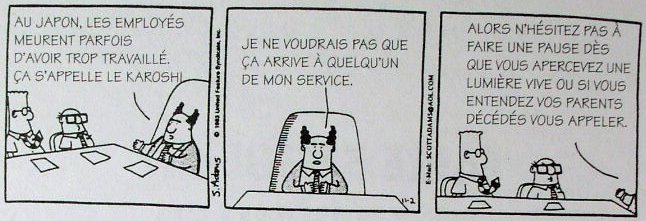
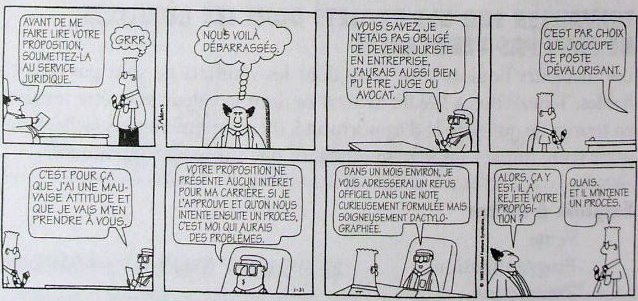
Dilbert - Entretien annuel
Lors d'un entretien annuel (ou encore 'entretien de progrés'), il est de bon ton de citer des potentiels à développer. Si vous ne voulez pas donner le baton pour vous faire battre, Dilbert vous propose quelques thèmes sans risques :
- dans l'intérêt de l'équipe, je dois apprendre à contrôler mon immense intelligence en présence de mes collègues moins privilégiés.
- je dois apprendre à me détendre au lieu de travailler 18 heures par jour.
- il faut que j'entre en contact avec une civilisation extra-terrestre car leur technologie est la seule chose qu'il me reste à comprendre.
- il faut que je devienne moins séduisant afin de ne plus distraire constamment mes collègues.
dimanche 4 décembre 2005
Spiritualité indienne
"Les mains qui aident sont plus sacrées que les lèvres qui prient".
Stya Saï Baba
Stya Saï Baba
vendredi 2 décembre 2005
Les Nuls - le pouce
"Si l'homme a un pouce, c'est pour qu'il ne tienne pas sa bite comme une cigarette "
Les Nuls - les films de cul
" Moi, les films de cul, j'aime bien me les faire dans une grande sale. "
Dominique Farrugia.
Dominique Farrugia.
Unreasonable man
“The reasonable man adapts himself to the world, the unreasonable one persists in trying to adapt the world to himself. Therefore, all progress depends on the unreasonable man…”
George Bernard Shaw
George Bernard Shaw
mardi 29 novembre 2005
samedi 26 novembre 2005
Dilbert - Les preneurs de risques
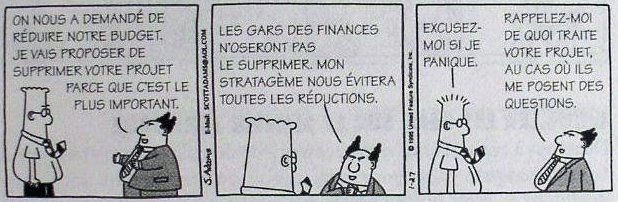
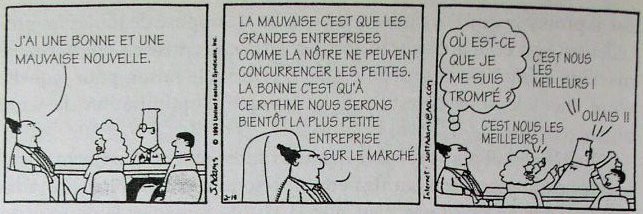
Par définition, les preneurs de risques échouent souvent. Les imbéciles aussi. Dans la pratique, il est difficile de les distinguer.
Comment peut-on alors affirmer récompenser les preneurs de risques ?
Comment peut-on alors affirmer récompenser les preneurs de risques ?
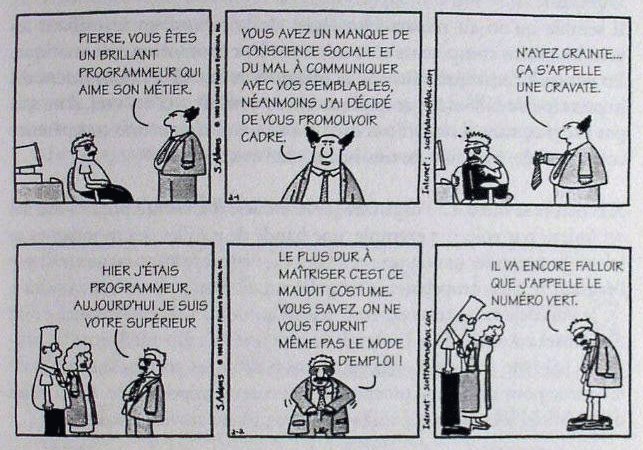
Dilbert - Nos problèmes actuels sont liés à la sexualité et au papier
Raisonnement :
Seule une personne sur un million est assez intelligente pour inventer la presse d'imprimerie. Par conséquent, lorsque la société ne comptait que quelques centaines d'antropoïdes troglodytes, les chances pour que l'un d'eux fût un génie étaient relativement faibles. Cela ne les empêchait toutefois pas de faire l'amour. Voir un déviant Géotrouvetout passer à travers les mailles du filet génétique devint, à chaque nouvelle naissance, plus probable. Quand plusieurs millions de personnes courent dans tous les sens à la recherche de relations sexuelles bon gré mal gré, les chances augmentent qu'une anthropoïde se retrouve un jour accroupie au beau milieu d'un champ en train de pondre un déviant, futur inventeur de la presse d'imprimerie.
Avec l'apparition de la presse, notre destin fût scellé. En effet, chaque fois qu'un déviant intelligent a eu une bonne idée, on a pu la mettre noir sur blanc et la diffuser. Chaque nouvelle idée a servi de base à de nouvelles idées. La civilisation a explosé. La technologie est née. La complexité de la vie s'est géométriquement accrue. Tout est devenu plus grand et mieux.
Sauf notre cerveau.
Toute la technologie qui nous entoure, toutes les théories de management, les modèles économiques qui prédisent et guident nos comportements, la science qui nous permet de vivre jusqu'à 80 ans, tout cela est le fruit de l'imagination d'un minuscule pourcentage de personnes intelligentes déviantes. Les autres dépensent toute leur énergie à faire du sur-place.
Le monde est trop complexe pour nous. L'évolution n'a pas suivi. Grâce à l'imprimerie, les déviants intelligents sont parvenus à conserver la trace de leur génie sur le papier et à le communiquer sans avoir à le transmettre par leurs gènes. L'évolution a été court-circuitée. Nous avons reçu la connaissance et la technologie avant l'intelligence.
Notre planète est peuplée de plus de 6 milliards de cornichons qui vivent dans une civilisation conçue par quelques milliers de déviants fabuleusement intelligents.
Seule une personne sur un million est assez intelligente pour inventer la presse d'imprimerie. Par conséquent, lorsque la société ne comptait que quelques centaines d'antropoïdes troglodytes, les chances pour que l'un d'eux fût un génie étaient relativement faibles. Cela ne les empêchait toutefois pas de faire l'amour. Voir un déviant Géotrouvetout passer à travers les mailles du filet génétique devint, à chaque nouvelle naissance, plus probable. Quand plusieurs millions de personnes courent dans tous les sens à la recherche de relations sexuelles bon gré mal gré, les chances augmentent qu'une anthropoïde se retrouve un jour accroupie au beau milieu d'un champ en train de pondre un déviant, futur inventeur de la presse d'imprimerie.
Avec l'apparition de la presse, notre destin fût scellé. En effet, chaque fois qu'un déviant intelligent a eu une bonne idée, on a pu la mettre noir sur blanc et la diffuser. Chaque nouvelle idée a servi de base à de nouvelles idées. La civilisation a explosé. La technologie est née. La complexité de la vie s'est géométriquement accrue. Tout est devenu plus grand et mieux.
Sauf notre cerveau.
Toute la technologie qui nous entoure, toutes les théories de management, les modèles économiques qui prédisent et guident nos comportements, la science qui nous permet de vivre jusqu'à 80 ans, tout cela est le fruit de l'imagination d'un minuscule pourcentage de personnes intelligentes déviantes. Les autres dépensent toute leur énergie à faire du sur-place.
Le monde est trop complexe pour nous. L'évolution n'a pas suivi. Grâce à l'imprimerie, les déviants intelligents sont parvenus à conserver la trace de leur génie sur le papier et à le communiquer sans avoir à le transmettre par leurs gènes. L'évolution a été court-circuitée. Nous avons reçu la connaissance et la technologie avant l'intelligence.
Notre planète est peuplée de plus de 6 milliards de cornichons qui vivent dans une civilisation conçue par quelques milliers de déviants fabuleusement intelligents.

vendredi 25 novembre 2005
Dilbert - Théorie de l'évolution
Au début, il y avait les amibes. Certaines amibes déviantes sont parvenues à mieux s'adapter à leur environnement et sont devenues des singes. Et puis on est passé au management par la Qualité Totale.
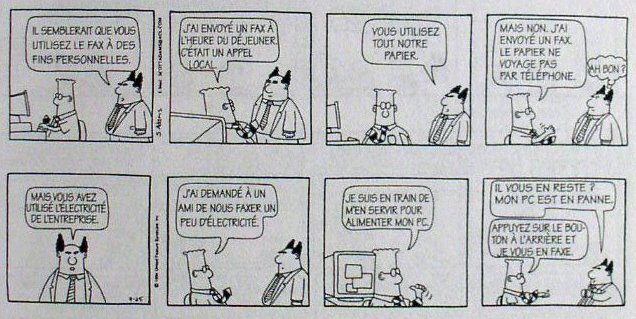
Dilbert - Absurdité 2
Une société décide de ne pas accorder d'augmentations mais de verser des primes à son personnel s'il atteint 5 des 7 objectifs fixés.
A la fin de l'année, les employés sont informés qu'ils ne toucheront pas de primes car ils n'ont atteint que 4 objectifs. Parmi les objectifs à côté desquels ils sont passés : le "moral des employés".
A la fin de l'année, les employés sont informés qu'ils ne toucheront pas de primes car ils n'ont atteint que 4 objectifs. Parmi les objectifs à côté desquels ils sont passés : le "moral des employés".
Dilbert - Absurdité 1
Une grande société n'hésite pas à lancer 2 projets en même temps :
- un programme de contrôle inopiné de prise de drogue
- un programme de "protection de la diginité personnelle"
dimanche 20 novembre 2005
mercredi 16 novembre 2005

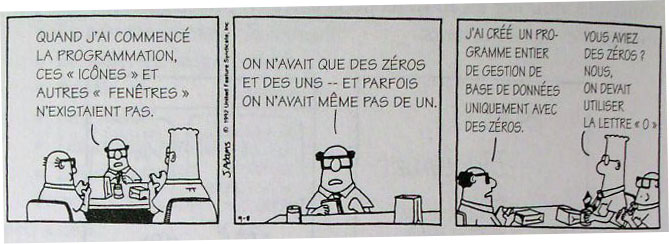
Freud a dit "Le diable est encore le meilleur subterfuge pour disculper Dieu." mais aussi "Le diable n'est pas autre chose que l'incarnation des pulsions anales érotiques refoulées.". Faut-il penser que Freud croyait que Dieu avait des pulsions ?
Au fait, pourquoi pense-t-on que Dieu est un homme ? Quelles preuves a-t-on ?
Au fait, pourquoi pense-t-on que Dieu est un homme ? Quelles preuves a-t-on ?
Inscription à :
Articles (Atom)